

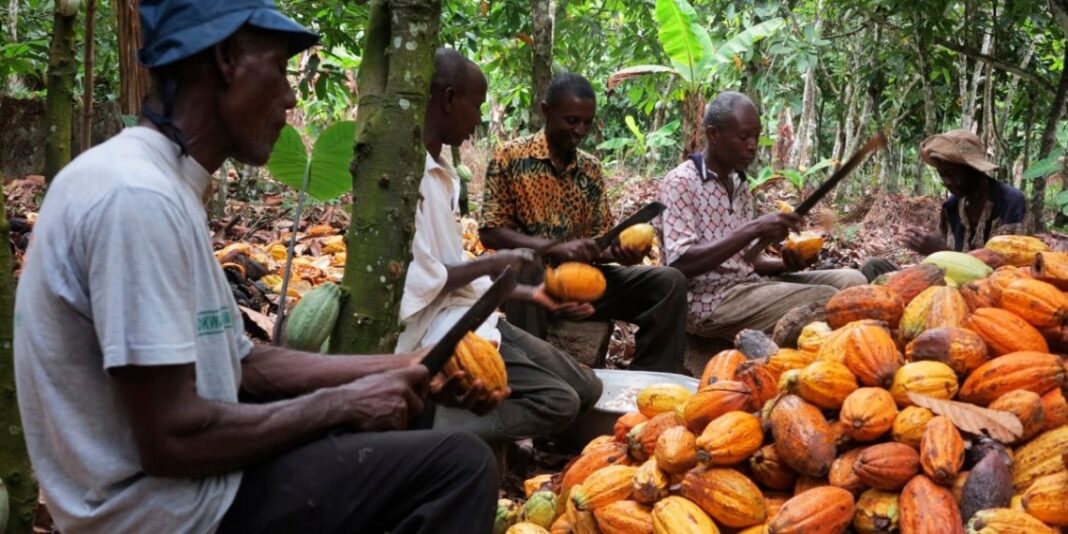
Ghana ranked fourth among cocoa bean exporters to Europe between 2021 and 2024, recording an average export share of 53.7 per cent, according to Fitch Solutions.
Cameroon led cocoa bean exports to the European Union (EU) during the period with an average share of 74.7 per cent, followed by Nigeria at 57.8 per cent and Côte d’Ivoire at 57.4 per cent.
Fitch Solutions said the figures highlight West Africa’s continued dominance in global cocoa production, while also exposing the region’s limited participation in higher-value stages of the cocoa supply chain.
The UK-based research firm noted that although expanding domestic cocoa processing could help producing countries capture more value, sustainability and traceability requirements are expected to play an increasingly important role in determining export flows, particularly to the European market.
“We believe the EU’s central role in global cocoa bean imports leaves West African producers highly exposed to developments within the bloc,” Fitch Solutions said.
The firm noted that West Africa accounts for approximately 65 per cent of global cocoa production and more than half of global cocoa bean exports. However, much of the region’s participation remains concentrated in the upstream production of raw cocoa beans, while significant value addition takes place elsewhere, particularly in Europe.
According to CNBC Africa, Nigeria, Côte d’Ivoire, Ghana and Cameroon collectively produce roughly 70 per cent of the world’s cocoa but capture only about 6 per cent of the value of a finished chocolate bar.
Fitch Solutions said the traditional model of exporting raw cocoa beans for processing in other countries is likely to face increasing pressure in the coming years, potentially changing the composition and direction of global cocoa trade.
West Africa’s Cocoa Trade Remains Focused on Raw Beans
The firm said the region’s export profile demonstrates the extent to which cocoa trade remains concentrated in raw and upstream products, while higher-value products such as cocoa paste, butter, powder and chocolate are predominantly exported by the EU.
Data from the International Trade Centre (ITC) showed that cocoa beans accounted for a significant proportion of exports from Cameroon, Côte d’Ivoire, Ghana and Nigeria in 2025, ranging from 5 per cent in Nigeria to 30 per cent in Cameroon, with an average of about 18 per cent across the four countries.
In comparison, processed and semi-processed cocoa products represented a much smaller share of exports. Cocoa paste averaged about 5 per cent, cocoa butter 4 per cent and cocoa powder just 1 per cent across the four countries, while chocolate exports remained negligible.
Meanwhile, the EU has consistently accounted for roughly two-thirds of global chocolate exports over the past five years, highlighting the significant share of value generated outside the major cocoa-producing countries.
The figures reinforce calls for greater investment in cocoa processing and value addition in West Africa, as producing countries seek to move beyond raw bean exports and secure a larger share of the global chocolate industry’s economic value.

Leave a Reply