

Kaduna, Nigeria – Care and Action Research (CaRE-NGO), with funding support from the United Nations Development Program (UNDP) through the Global Environment Facility Small Grants Programme (GEF-SGP) Nigeria, has showcased the achievements of its one-year Climate-Smart Agriculture Project, an initiative designed to improve food security, promote environmental sustainability, and create alternative livelihood opportunities in Kaduna State.
Launched in 2025, the project trained 450 beneficiaries in climate-smart agricultural practices through three phases, with 150 participants enrolled in each phase. The initiative concluded with a knowledge-sharing and experience management workshop held in Kaduna, where farmers, government officials, development practitioners, students, and community representatives reviewed the project’s impact, documented lessons learned, and explored ways to expand the initiative to more communities.
Speaking at the workshop on Thursday, Mr. Mendos Dogo, Project Officer of CaRE-NGO, said the project was developed to address the growing challenges of climate change and food insecurity by equipping participants with practical agricultural skills that can improve livelihoods and strengthen resilience.
One of the project’s key innovations was teaching farmers how to convert agricultural waste into valuable products instead of allowing it to become an environmental hazard.
According to Dogo, farm residues such as maize cobs, rice husks, and groundnut shells, which are often burned or discarded after harvest, can be processed into nutritious livestock and fish feed when treated with appropriate supplements.
“We have shown that what many people consider waste can become a valuable resource. Instead of burning agricultural residues, farmers can transform them into products that reduce production costs and create additional sources of income,” he said.
The project also introduced participants to Black Soldier Fly farming, demonstrating how maggot production can provide an affordable and sustainable alternative to expensive commercial fish feed.
Beyond conventional farming, the initiative promoted urban agriculture, teaching participants how to grow crops in limited spaces using sacks, containers, rooftops, and other available areas. Beneficiaries also received practical training in beekeeping, organic farming, and Azolla cultivation, an aquatic plant widely used as a nutritious feed for poultry and fish.
Dogo noted that the project challenged common misconceptions about urban beekeeping by demonstrating that bees can be safely managed in residential areas using modern beekeeping techniques. He added that demonstration sites established under the project have already produced successful honey harvests, while processing equipment provided through GEF-SGP funding is helping beneficiaries convert agricultural waste into livestock feed.
He expressed satisfaction that many participants have embraced the innovations and are already applying the skills gained during the training.
Coordinator of CaRE-NGO, Professor Bala Dogo, explained that the workshop was organized to evaluate the project’s outcomes, document best practices, and create a platform for beneficiaries and stakeholders to exchange ideas and experiences.
According to him, the initiative was introduced in response to the growing threats posed by climate change, insecurity, and limited access to farmland.
He observed that many farmers in Kaduna State are no longer able to cultivate distant farms due to insecurity, while unpredictable rainfall patterns continue to reduce agricultural productivity.
Professor Dogo said climate-smart agriculture offers practical solutions by helping farmers improve productivity, adapt to changing weather conditions, and reduce environmental degradation.
He urged Nigerians to stop burning agricultural waste, emphasizing that crop residues should instead be recycled into valuable products capable of generating income while protecting the environment.
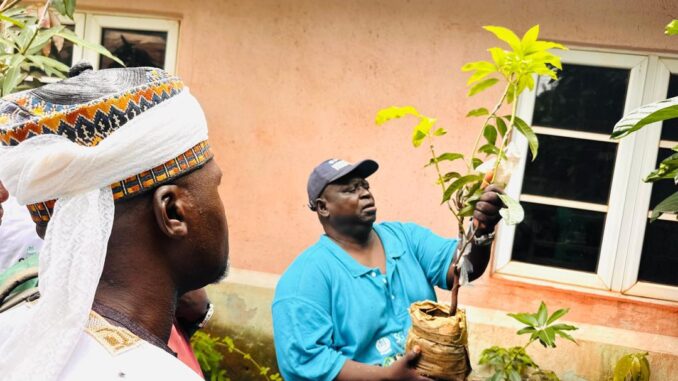
The professor also encouraged households, schools, and institutions to plant high-value economic trees, noting that doing so can improve environmental quality while providing additional sources of food and income.
He further advocated for backyard farming and other space-saving agricultural technologies, stressing that successful farming does not always require large areas of land.
Professor Dogo revealed that CaRE-NGO has worked closely with the Kaduna State Ministries of Agriculture and Environment, tertiary institutions, and local fabricators throughout the implementation of the project.
He explained that government agencies provided technical support, while universities contributed expertise in areas including taxonomy, mapping, and climate-resilient agricultural practices.
He also emphasized the importance of continuous training, encouraging aspiring farmers to acquire the necessary knowledge and technical skills before venturing into specialized agricultural enterprises.
Several beneficiaries and student interns described the project as life-changing.
A 300-level Development Communication student at the University of Abuja, Kumsat Kyer’an Jonathan, said the internship exposed her to innovative climate-smart farming techniques and strengthened her understanding of behavioral change communication.
She expressed confidence that the knowledge she gained would enable her to promote sustainable agricultural practices within her community.
Another participant, Miss Favour Danjuma, a Plant Science and Biotechnology student at Nasarawa State University, said the practical training on grafting and other modern farming techniques has the potential to significantly improve agricultural productivity if widely adopted across Nigeria.
Participants called for similar initiatives to be replicated in other states, saying the project has demonstrated how practical agricultural training can empower young people, improve food security, create employment opportunities, and promote sustainable environmental management.
With the successful completion of the one-year intervention, stakeholders expressed optimism that wider adoption of climate-smart agriculture, agricultural waste recycling, and innovative farming techniques will strengthen resilience to climate change, improve livelihoods, and support sustainable agricultural development in Kaduna State.

Leave a Reply