

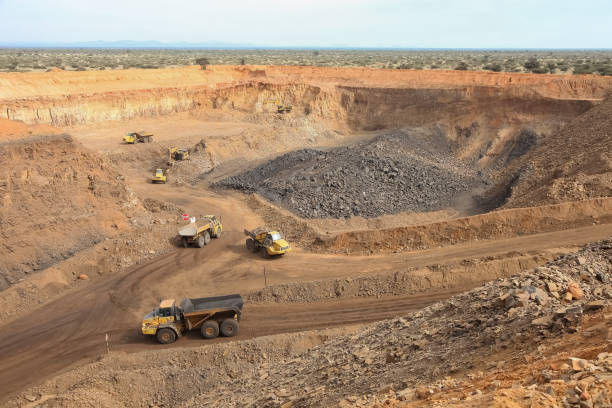
As the world races towards electric vehicles and renewable energy, one African country has decided it no longer wants to be known simply as a supplier of raw minerals.
Zimbabwe, home to some of the world’s largest hard-rock lithium deposits, has embarked on one of its boldest economic policy shifts in decades, restricting the export of unprocessed lithium in a bid to build a domestic processing industry and capture more value from the mineral powering the global clean energy transition.
The decision has reverberated well beyond Zimbabwe’s borders.
Known as “white gold”, lithium has become one of the world’s most strategic minerals. It is an essential ingredient in rechargeable batteries used in electric vehicles, smartphones, renewable energy storage systems and countless electronic devices.
With global demand projected to continue rising over the coming years, Zimbabwe’s move has introduced fresh uncertainty into international supply chains while reigniting debate over who truly benefits from Africa’s natural resources.
More than a mining story
Zimbabwe’s connection to lithium predates the global electric vehicle boom.
The country, often referred to as the “Jewel of Africa”, possesses some of the world’s richest hard-rock lithium deposits, concentrated around Bikita, Goromonzi and Kamativi.
For years, much of this mineral wealth left the country in its raw form.
Foreign mining companies, many of them Chinese, extracted lithium ore before shipping it overseas for refining, where substantially more value was added before the finished materials entered global battery manufacturing.
Zimbabwe supplied the raw resource, while much of the economic value was created elsewhere.
Government officials argue this model has done little to maximise the country’s mineral wealth.
That thinking led to a major policy shift.
In December 2022, Zimbabwe prohibited exports of raw, unprocessed lithium ore, arguing that the country should no longer remain at the lowest end of the global value chain.
Rather than exporting raw materials, authorities want companies to process lithium inside Zimbabwe before it reaches international markets.
Initially, the government planned to extend restrictions on lithium concentrates from 2027. However, after authorities observed rising shipments of unprocessed material and increased artisanal mining activity, implementation was accelerated by ten months.
The decision immediately caught the attention of battery manufacturers, commodity traders and investors across the world.
Why lithium matters

Lithium has become indispensable to the clean energy transition because of its exceptional ability to store and release energy efficiently.
The mineral is extracted primarily through two methods.
Countries such as Zimbabwe and Australia mine hard-rock deposits, while nations including Chile, Argentina and Bolivia recover lithium from underground brine reservoirs through evaporation.
Mining, however, is only the beginning.
Before lithium can power an electric vehicle or store renewable energy, it must undergo several stages of processing.
Ore is first crushed and concentrated into materials such as spodumene concentrate before being refined into lithium carbonate or lithium hydroxide, the chemical compounds required for battery production.
Today, most of that refining takes place in China.
Zimbabwe wants a greater share of that industrial activity to happen within its own borders.
By encouraging domestic processing, authorities hope to attract investment in refineries, expand industrial capacity and retain more of the value generated from its mineral resources.
A pillar of Vision 2030
The lithium strategy forms part of Zimbabwe’s broader Vision 2030 programme, which seeks to transform the country into an upper-middle-income economy.
Government officials believe processing minerals locally could generate significantly higher export earnings than selling raw ore.
They also expect the policy to create skilled and semi-skilled employment, stimulate investment in industrial infrastructure, strengthen transport networks and reduce dependence on foreign refiners.
Zimbabwe’s Minister of Mines and Mining Development, Polite Kambamura, said producers increased both production and exports after government announced its intention to tighten export rules.
Applications for export permits also surged as companies sought to move as much product as possible before the restrictions took full effect.
Yet not everyone is convinced the transition will be straightforward.
Critics warn that limited infrastructure, technical expertise and industrial capacity could create bottlenecks, particularly for smaller mining companies and artisanal miners.
Markets react
Global commodity markets responded quickly.
Lithium carbonate prices on the Asia-Pacific Commodity Exchange rose by almost 12 per cent within a week of Zimbabwe’s announcement, highlighting concerns about potential disruptions to supply.
China, which refines nearly 70 per cent of the world’s lithium, found itself at the centre of those concerns.
Chinese companies have invested heavily in Zimbabwe’s mining sector over the past decade and rely on the country’s lithium deposits to support battery production.
Although higher prices reflected short-term uncertainty, companies operating in Zimbabwe argued the longer-term impact could be managed.
The export restrictions apply mainly to unprocessed materials, meaning companies willing to invest in refining facilities inside Zimbabwe may continue operating while aligning with government policy.
Among them is Sinomine Resource Group, which has announced plans to construct a US$300 million lithium carbonate plant near Bikita with the aim of reaching full production by 2027.
Several Chinese firms are also expanding investments in local processing rather than limiting themselves to extraction.
The shift could ultimately strengthen Zimbabwe’s industrial ambitions while allowing China to retain a central role in the global battery supply chain.
Beyond China
Zimbabwe’s policy is also prompting attention from Europe and North America.

Western vehicle manufacturers and battery producers are reassessing supply strategies as governments seek to diversify access to critical minerals.
The European Union’s Critical Raw Materials Act reflects growing efforts to reduce dependence on concentrated supply chains.
Industry analysts suggest countries such as Namibia and Mozambique could attract greater investment as manufacturers seek additional lithium sources with fewer export restrictions.
At the same time, Zimbabwe’s decision has fuelled wider conversations across Africa.
Resource-rich countries including Namibia and the Democratic Republic of Congo are reportedly considering similar approaches to cobalt, copper and lithium, seeking to retain more value through domestic processing rather than exporting raw minerals.
Opportunities and obstacles
While policymakers present lithium beneficiation as an opportunity for industrial transformation, implementation presents significant challenges.
Processing lithium requires specialised chemical facilities, consistent electricity supply, skilled workers and strict environmental safeguards.
Experts caution that developing these capabilities will take substantial investment.
Workers have also expressed concerns that production delays during the transition could affect employment or increase safety risks if processing facilities expand without adequate expertise.
Health and environmental advocates have raised additional concerns.
They warn that lithium refining produces chemical by-products requiring careful handling and monitoring.
Without robust environmental safeguards, communities could face pollution risks similar to those experienced in other extractive industries.
Artisanal miners also fear being left behind.
Many lack the capital, technology and infrastructure needed to process lithium independently, leaving them dependent on licensed buyers or vulnerable to illegal trading networks.
Questions have also emerged over Zimbabwe’s ability to monitor secondary minerals such as tantalum, beryl and tin, which are commonly found alongside lithium deposits.
Authorities have proposed establishing additional testing laboratories and strengthening customs controls, although implementation has progressed unevenly.
Balancing ambition with reality
In April 2026, Zimbabwe introduced new export quotas and conditions allowing compliant companies to resume limited shipments.
Exporters must now demonstrate that at least half of processing takes place domestically before products can leave the country.
The measure reflects government’s attempt to balance industrial development with commercial realities.
Officials estimate that local lithium processing could generate up to US$1.5 billion annually by 2030 if infrastructure and workforce development keep pace with mining expansion.
Whether those projections become reality depends on far more than mineral reserves.
Industry analysts argue success will require reliable electricity, improved transport infrastructure, investor confidence, policy consistency and continued skills development.
A defining moment for Africa’s mineral future
Zimbabwe’s lithium strategy reaches beyond national borders.
It reflects a growing determination among African countries to move beyond simply exporting raw materials while others capture the greatest economic returns through manufacturing.
The policy challenges long-standing patterns in global trade where developing countries supply resources and developed economies dominate processing, manufacturing and technology.
Supporters view the strategy as an opportunity to reshape Africa’s role in the global clean energy economy.
Critics caution that success depends on careful implementation, transparent regulation and sustained investment.
If Zimbabwe succeeds, it could become Africa’s first major lithium refining hub and provide a blueprint for other resource-rich nations seeking greater control over their mineral wealth.
If it falls short, the country risks repeating a familiar cycle in which abundant natural resources generate limited long-term development.
As demand for lithium continues to rise, Zimbabwe’s “white gold” is no longer just fuelling batteries. It has become central to a broader debate about industrialisation, economic sovereignty and how the benefits of the global energy transition should be shared.

Leave a Reply