

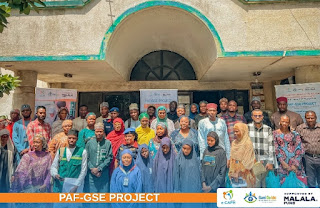
The Enhancing Communities Action for Peace and Better Health Initiative (e-CAPH) has called for stronger policies, adequate funding and improved accountability to expand access to secondary education for girls in Kaduna State, Nigeria.
The organisation made the call during the PAF-GSE Kaduna Stakeholder Engagement Meeting held on Thursday, 15 October 2026, alongside activities marking the International Day of the Girl Child. The engagement, supported by the Malala Fund, brought together government officials, education professionals, development partners and community representatives to discuss practical measures for improving girls’ access to secondary education.
The meeting also provided an opportunity for girls, including adolescent mothers and those facing exclusion from formal education, to share their experiences and priorities with institutions responsible for education and child protection.
Discussions focused on the policies, financing arrangements and support systems needed to help girls enrol in school, remain in education, return after interruptions and complete their secondary education.
Project Coordinator Khadija Lawal Aliyu said stakeholders must move beyond policy commitments and focus on practical actions that address the barriers preventing girls from accessing quality education.
She emphasised that sustainable progress would require effective policy implementation, adequate and gender-responsive funding, stronger monitoring mechanisms and clear accountability structures. She also highlighted the need for coordination among institutions responsible for education, healthcare, protection and social support.
Participants examined several challenges affecting girls’ education in Kaduna State, including inadequate education financing, school safety concerns, child marriage, adolescent motherhood, school retention, re-entry opportunities and weak accountability mechanisms.
The engagement attracted representatives from the Kaduna State Ministries of Education, Finance, and Women Affairs and Social Development, as well as the state’s Planning and Budget Commission.
Other participating institutions included the Kaduna State Universal Basic Education Board (KADSUBEB), Kaduna State Bureau of Education Monitoring and Accountability (KADBEAM), UNFPA Nigeria, Save the Children, Girl Effect, Smart Aid Initiative, the Nigeria Security and Civil Defence Corps (NSCDC) and the National Agency for the Prohibition of Trafficking in Persons (NAPTIP).
During the meeting, e-CAPH presented policy briefs and evidence on education financing, school re-entry, retention, safety and accountability. The presentations allowed stakeholders to examine identified gaps, clarify institutional responsibilities and discuss areas requiring immediate intervention.
A documentary featuring the experiences of girls was also unveiled to ensure their perspectives remained central to discussions about policies and programmes affecting their education.
A key outcome of the engagement was the identification of specific institutional commitments and follow-up actions intended to strengthen implementation. Stakeholders identified immediate priorities, designated focal persons and established coordination mechanisms to support progress on agreed measures.
Commitment cards were also introduced to document the actions expected from participating institutions, the officials responsible, implementation timelines and indicators for measuring progress.
According to e-CAPH, improving girls’ educational outcomes requires more than increasing school enrolment. It also depends on establishing systems that enable girls to learn in safe environments, access appropriate health and protection services, and return to school when circumstances interrupt their education.
Child marriage, pregnancy, financial hardship and inadequate support systems can prevent girls from completing secondary school. Addressing these challenges requires coordinated action from government institutions, schools, families, communities and development organisations.
The organisation stressed that education policies must be supported by responsive financing and effective implementation mechanisms to ensure that girls, particularly those from vulnerable backgrounds, are not excluded from learning opportunities.
It further noted that collaboration among education authorities, healthcare providers, social welfare agencies and child protection institutions would be essential to supporting girls who need additional assistance to remain in school or return after an interruption.
“As the PAF-GSE Project progresses, e-CAPH will continue to work with government institutions, development partners, civil society, communities, schools and girls to strengthen coordination and accountability around girls’ secondary education in Kaduna State,” the organisation said.
Aliyu reiterated that the objective was not simply to get girls into school but to strengthen the systems that allow them to remain in education, return when their schooling is interrupted and complete their secondary education.
The PAF-GSE Kaduna Project, supported by the Malala Fund and implemented by e-CAPH, focuses on strengthening policy implementation, education financing and accountability across Kaduna State. The initiative aims to improve educational opportunities for girls facing barriers to accessing and completing secondary education.
As the project advances, the effectiveness of the commitments made during the stakeholder engagement will depend on sustained collaboration, transparent monitoring and measurable action by the responsible institutions.
Ensuring that education budgets respond to girls’ needs, schools provide safe learning environments and effective re-entry pathways are available will be essential to translating policy commitments into tangible results.

Leave a Reply