

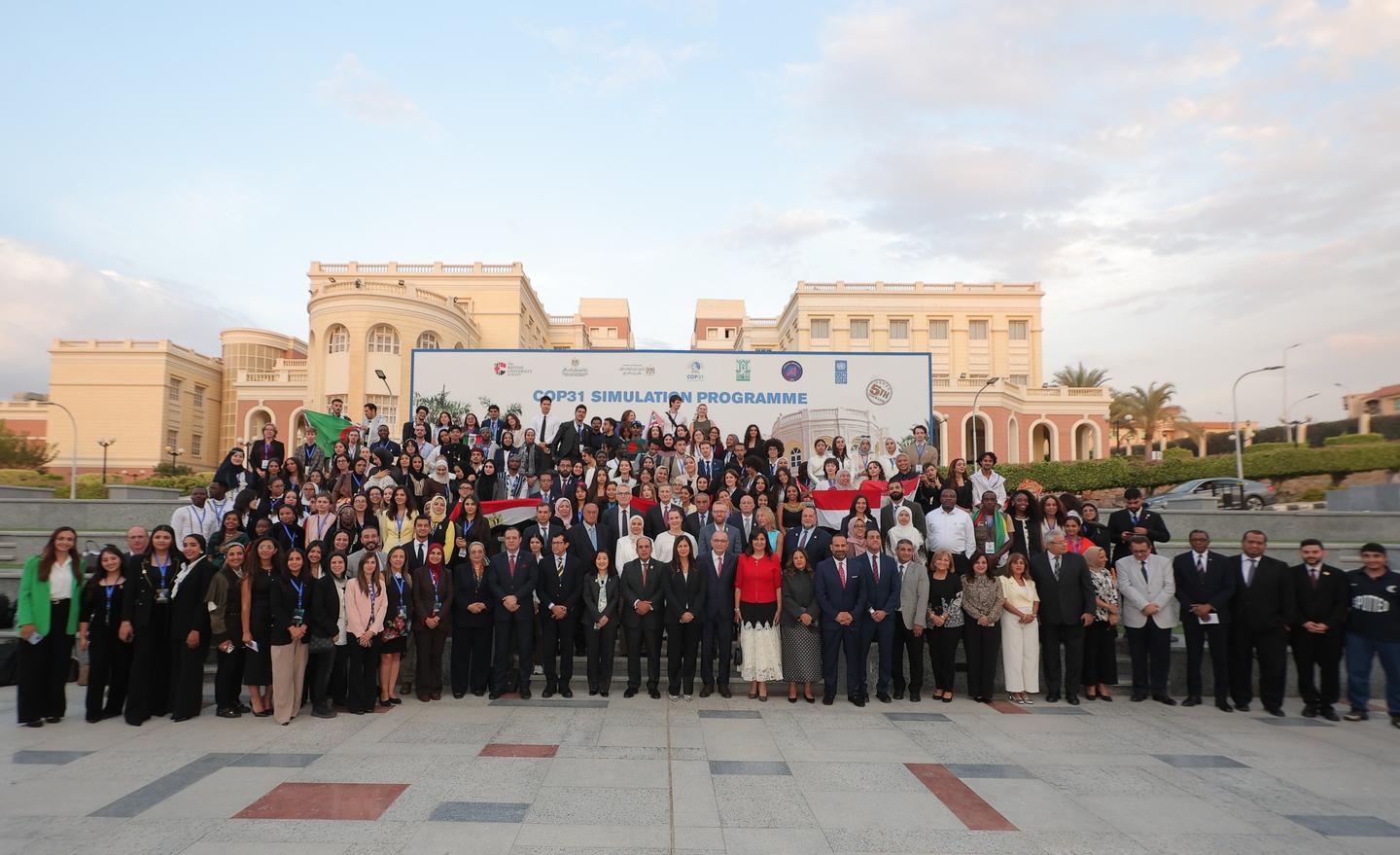
The United Nations Development Programme (UNDP) in Egypt and the British University in Egypt (BUE) have concluded the fifth edition of their COP Simulation Programme, bringing together 150 students from 43 countries and 115 universities to develop climate policy recommendations and strengthen their skills in international negotiations.
The programme provided participants with practical experience in climate diplomacy through scientific research, policy development and simulated negotiations. Students explored how countries can navigate competing national interests, build consensus and develop collective responses to global climate challenges.
This year’s cohort also included students from 25 Egyptian universities, reflecting the programme’s continued commitment to expanding youth participation in climate policy and international cooperation.
The closing ceremony featured a vote on the COP31 Simulation Declaration, which outlines the students’ proposed solutions to climate challenges. The recommendations and outcomes are expected to be presented at the 31st United Nations Climate Change Conference (COP31), scheduled to take place in Antalya, Türkiye, in November 2026.
H.E. Dr. Manal Awad, Egypt’s Minister of Local Development and Environment, attended the closing ceremony as the principal guest of honour. She highlighted the programme as an example of collaboration between government institutions, universities and international development partners.
Dr Awad emphasised that effective climate action requires investment not only in policies and strategies but also in people, knowledge and skills. She welcomed the initiative for helping young people understand international negotiations and develop shared approaches to addressing climate challenges.
Chitose Noguchi, UNDP Resident Representative in Egypt, said young people must be recognised as active partners in shaping and implementing climate solutions rather than simply observing the effects of climate change.
“Young people are not simply observers of the climate challenges we face, or recipients of decisions on climate. They are active partners in shaping solutions and turning them into reality,” Noguchi said.
She added that investing in young people and creating opportunities for them to participate in negotiations, influence policies and assume leadership roles are essential to strengthening the skills and confidence needed to advance climate action.
Ambassador Wael Abouelmagd, Assistant Minister of Foreign Affairs for Climate, Environment and Sustainable Development, highlighted the importance of practical experience in multilateral diplomacy.
He noted that the programme enables students to listen to different perspectives, understand national interests and build trust while working towards agreements on complex climate issues.
Emphasising that “the real work begins when negotiations end”, Abouelmagd stressed that international agreements must translate into meaningful improvements in people’s lives. He also underscored the importance of preparing young people to contribute to the implementation of climate commitments.
Dr Abeer Shakweer, Inclusive Growth and Digital Transformation Team Leader at UNDP in Egypt, said the students’ ability to navigate complex negotiations and reach consensus demonstrated their readiness to contribute to climate action.
She explained that the programme had developed beyond an academic exercise into a platform for producing integrated recommendations connecting environmental sustainability, economic development and wider social priorities.
The resulting declaration is expected to provide a youth perspective on key climate issues ahead of COP31 in Türkiye.
Ahead of the closing ceremony, participants presented findings from the programme’s Climate Finance and Debt and Just Transition research laboratories during a high-level dialogue with Dr Mahmoud Mohieldin, United Nations Special Envoy on Financing the 2030 Sustainable Development Agenda and Chair of the High-level Expert Group on Debt.
The discussions examined the feasibility of the students’ proposals, with particular attention to climate finance, climate justice, debt resolution and the transition towards more sustainable economies.
Participants also explored the roles of international and regional financial institutions and banks in mobilising resources to support climate action and sustainable development.
The dialogue provided an opportunity for students to test their recommendations against real-world policy and financing challenges. Dr Mohieldin expressed hope of meeting the participants again at COP31.
The focus on climate finance and debt reflects ongoing concerns about how developing countries can secure the resources needed to address climate risks while managing existing financial pressures and pursuing economic development.
Dr Sarah El-Khishin, Associate Pro-Vice Chancellor for Strategy and Data at BUE and Founding Director of the COP Simulation Programme, stressed the importance of ensuring that young people from developing countries and climate-vulnerable small island states have a voice in global climate discussions.
She also called for climate policymaking grounded in scientific evidence and reliable data, alongside climate finance delivered at the scale and on the terms countries require to support recovery and sustainable development.
The COP Simulation Programme has expanded from an initiative established alongside Egypt’s presidency of COP27 into an international platform connecting academic research with climate diplomacy.
Its growing network includes more than 40 professors and academics, 30 coordinators and experts supporting negotiating sessions and blocs, over 20 policymakers and diplomats, and more than 30 international and academic partners.
BUE, under the leadership of President and Vice-Chancellor Professor Mohamed Loutfi and Board of Trustees Chair Farida Khamis, hosted this year’s programme in collaboration with UNDP in Egypt and Akdeniz University in Antalya, Türkiye.
The initiative was held under the auspices of Egypt’s Ministry of Higher Education and Scientific Research, Ministry of Foreign Affairs, International Cooperation and Egyptian Expatriates, Ministry of Local Development and Environment, and the Egyptian Environmental Affairs Agency.
Ambassador Salih Mutlu Şen, Türkiye’s Ambassador to Egypt, commended UNDP and BUE for equipping students with practical skills in climate diplomacy through research, training and negotiations.
With Türkiye preparing to host COP31, he expressed hope that participants would apply their knowledge in future international forums and contribute to cooperation on shared climate challenges.
Other guests at the closing ceremony included Ambassador Amre Moussa and Ambassador Nabila Makram, members of BUE’s Board of Trustees, as well as Dr Ashraf Sobhy, former Minister of Youth and Sports.
As preparations continue for COP31, the fifth edition of the COP Simulation Programme highlights the role universities and development partners can play in preparing young people for international climate negotiations.
By combining research, policy writing and simulated diplomacy, the initiative gives students an opportunity to understand the complexities of climate policymaking and develop recommendations on issues affecting countries and communities worldwide.
The expected presentation of the COP31 Simulation Declaration in Antalya will provide an opportunity to bring these youth perspectives into wider climate discussions.
Ultimately, the programme seeks to bridge the gap between academic knowledge and policy implementation, preparing a new generation of climate leaders to contribute to international cooperation, equitable climate finance and sustainable development.
With climate change continuing to place pressure on economies and vulnerable communities, meaningful youth participation will remain an important part of efforts to turn international commitments into practical action.

Leave a Reply