

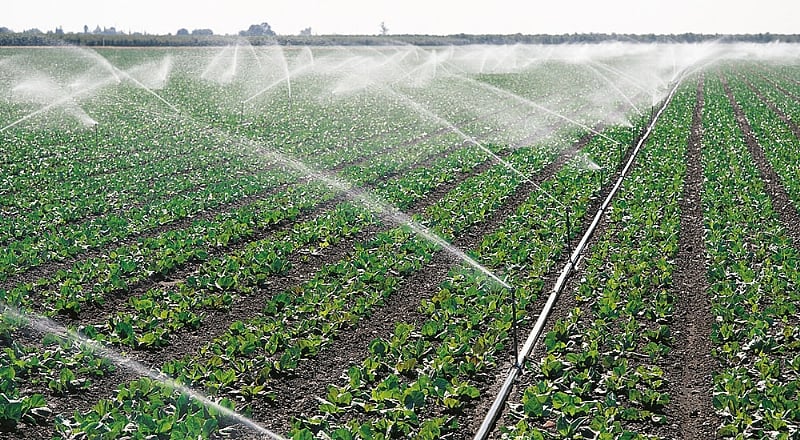
The government has announced plans to rehabilitate all 22 existing irrigation facilities in the Volta Region by the end of 2027 as part of efforts to transition Ghana from rain-fed agriculture to year-round irrigation farming.
The Minister for Food and Agriculture, Eric Opoku, announced the plan at the national launch of the Ghana Tomato Self-Sufficiency Initiative (GHATSI) at Anloga in the Volta Region.
Launched on September 15, 2026, GHATSI is being implemented by the Ministry of Food and Agriculture in partnership with FarmMate Limited. The initiative seeks to establish a reliable, year-round domestic tomato value chain, reduce Ghana’s dependence on tomato imports and improve incomes for farmers.
According to Mr Opoku, the rehabilitation of the irrigation facilities is part of the government’s response to President John Dramani Mahama’s directive to accelerate the country’s transition from rain-fed agriculture to irrigation-based farming.
He said an assessment of irrigation infrastructure across the country had revealed that several facilities constructed over the years were operating below their designed capacities due to deterioration and inadequate maintenance.
The government, he said, would therefore rehabilitate existing irrigation infrastructure while developing new facilities to expand access to water for agricultural production.
Mr Opoku also disclosed that two new irrigation dams were being pursued in the Volta Region. In addition, two excavators would be provided to the Volta Regional Coordinating Council to support the dredging of lagoons, streams and rivers and improve water flow for irrigation.
Mobile irrigation systems
The Minister also announced the introduction of mobile irrigation systems to improve farmers’ access to irrigation water.
Each system comes with a 10-horsepower diesel-powered water pump, medium-sized pipes, 44 sprinklers and 44 risers, with one unit capable of irrigating approximately five acres.
Under the arrangement, the government will subsidise 60 per cent of the cost, while farmers will finance the remaining 40 per cent, equivalent to GH¢23,800.
Farmers unable to make the payment upfront will have the option of acquiring the equipment through a two-year hire-purchase arrangement.
Mr Opoku said the intervention was aimed at making irrigation equipment more accessible and enabling farmers to increase production throughout the year.
The government has also begun expanding access to water-pumping equipment, with 100 machines already distributed through the Regional Minister and procurement underway for an additional 500 machines.
Improved seeds and fertiliser support
The Minister further outlined measures to improve farmers’ access to improved seeds and fertiliser.
He said the Ministry had reached an agreement with the Council for Scientific and Industrial Research (CSIR) to develop improved seeds capable of producing yields of between 25 and 30 tonnes.
The seeds are expected to be available by the end of November, after which they will be procured and distributed to farmers.
The government has also procured organic fertiliser for farmers and allocated 200 cartons to support subsistence and vegetable farmers in the Volta Region.
Mr Opoku explained that the free fertiliser intervention was introduced as an emergency measure following disasters, including the Akosombo Dam spillage and drought conditions in parts of northern Ghana, which resulted in significant losses to farmers.
Volta Region commends government
The Volta Regional Minister, James Gunu, commended President Mahama and the Ministry of Food and Agriculture for what he described as significant investments in agriculture in the region.
He said the interventions demonstrated the government’s commitment to supporting farmers, increasing food production and strengthening food security.
Mr Gunu recalled that following the celebration of National Farmers’ Day in the Volta Region under the theme, “Eat Ghana, Feed Ghana, Secure the Future,” the region received more than 20,000 bags of fertiliser for distribution to farmers.
He said each of the region’s 18 district assemblies subsequently received fertiliser, while the region also benefited from additional supplies under the government’s agricultural interventions.
The Regional Minister added that the Volta Region had received 180,000 birds under the Feed Ghana poultry support programme, while two of the 10 Farmers’ Service Centres being constructed nationwide had been allocated to the region.
“If the entire country is receiving 10 projects and the Volta Region is receiving two of them, that should tell you how much attention this government is giving to the development and agricultural transformation of the people of the Volta Region,” he said.
Mr Gunu said the region had significant potential for tomato production, particularly in Anloga, Keta, Akatsi North and Agotime Ziope, and called for the expansion of GHATSI to cover more tomato-producing communities.
He also appealed for the establishment of a tomato processing facility in the region to reduce post-harvest losses, create jobs and enable farmers to derive greater value from their produce.
GHATSI targets 100,000 tonnes of tomatoes
The GHATSI initiative is targeting initial tomato production of about 100,000 tonnes during the 2026/2027 production cycle, with a long-term goal of reaching approximately 400,000 tonnes annually.
The programme is designed to connect farmers to irrigation, improved inputs, financing, technical support, crop insurance, processing, logistics and guaranteed markets.
Mr Opoku said the broader objective was to establish a dependable, year-round tomato value chain capable of addressing Ghana’s seasonal tomato shortages, reducing post-harvest losses and creating opportunities for value addition and exports.
The launch at Anloga brought together government officials, traditional leaders, farmers, Members of Parliament, local government representatives and private-sector stakeholders.
The government says the combined development of irrigation infrastructure, access to improved agricultural inputs, financing, market linkages and processing facilities will be critical to strengthening food security and reducing Ghana’s dependence on imported agricultural products.

Leave a Reply