

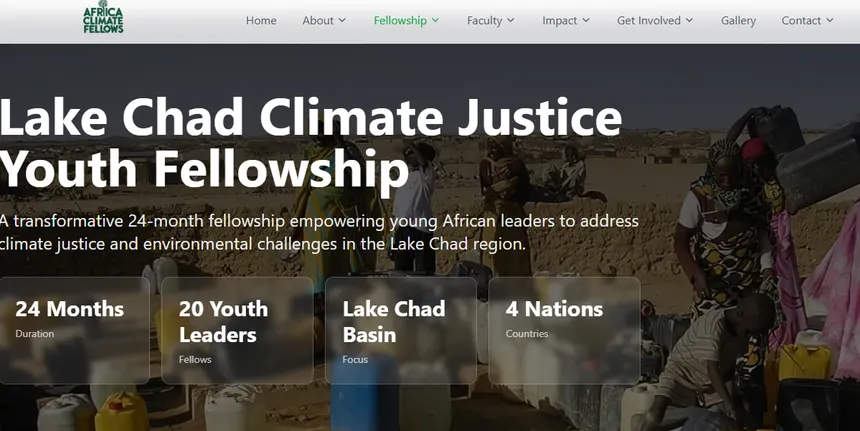
A two-year fellowship for 20 young climate advocates from Cameroon, Chad, Niger and Nigeria is supporting community-focused climate justice work across the Lake Chad Basin.
The Development of Educational Action Network launched the programme with support from the Climate Justice Resilience Fund. The original call described a 24-month learning and leadership initiative designed to equip participants for advocacy and community change.
Programme updates indicate that fellows have moved into seed-grant proposal development for locally led projects. Because the linked roundup framed the initiative as an open fellowship after its recruitment phase, this article treats it as an ongoing development rather than a current application opportunity.
The basin supports millions of livelihoods and faces overlapping pressures from environmental stress, poverty, insecurity and displacement. Fellows are expected to connect climate justice with community priorities rather than pursue climate action in isolation.
Across Lake Chad Basin, climate and environmental pressures increasingly intersect with health, livelihoods, infrastructure and inequality. Communities with the smallest financial cushion are usually least able to absorb crop losses, pollution, water interruptions, displacement or higher energy and food costs.
That makes implementation as important as ambition. Effective action around Lake Chad Climate Justice Youth Fellowship requires transparent finance, credible institutions, local knowledge and meaningful community participation. Without those elements, well-publicised commitments can fail to reach people living closest to the problem.
The distribution of costs and benefits deserves close attention. New finance, infrastructure or policy can create jobs and resilience, but it can also bypass informal workers, rural communities and people whose land or livelihoods are affected. Social-impact reporting therefore needs to examine ownership, compensation, affordability and participation alongside technical performance.
Locally produced evidence can improve those decisions when researchers and authorities share findings in usable forms and communities can challenge assumptions. The strongest interventions will connect environmental indicators with household outcomes such as health, income, time savings, food security and protection from displacement.
Young people in the basin live with the consequences of decisions on water, land, security and adaptation. Locally led funding can help them test solutions and influence policies that are otherwise designed far from affected communities.
What happens next will matter more than the announcement itself. Useful indicators include the release of implementation plans, budgets or court decisions; independent evidence of who benefits; and opportunities for affected communities to shape delivery and report problems.
Social Impact News will continue to treat official, organisational and advocacy claims as attributed statements unless they are supported by independent evidence. That distinction is particularly important where outcomes are contested, prospective or still dependent on funding and implementation.
Readers should also watch for the less visible effects that sit behind headline milestones. These include whether frontline organisations receive resources on time, whether women and young people participate in decisions, whether rural and marginalised communities can access benefits, and whether new systems remain affordable. Reporting on those questions over time will show whether the initiative produces durable change or only a short cycle of announcements and events.

Leave a Reply