

For many Africans who sought opportunity in South Africa, the country once symbolised hope.
It was a place where entrepreneurs opened businesses, professionals built careers and families dreamed of a better future in one of Africa’s largest economies.
Today, for thousands of migrants, that dream has been replaced by uncertainty, fear and hurried journeys back home.
A wave of anti-immigrant demonstrations sweeping across South Africa has triggered mass departures, raised difficult questions about African unity and revived painful memories of a country that once fought one of the world’s most oppressive systems of racial segregation.
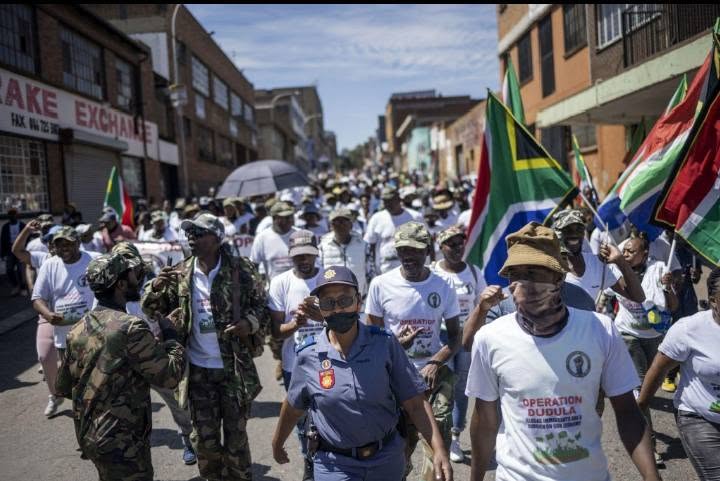
The images emerging from the streets have been striking.
Marchers demanding the removal of undocumented migrants have filled roads across several cities, with June 30 serving as the unofficial deadline set by more than 20 civil society groups for foreigners without legal status to leave the country.
While many demonstrations remained peaceful, others descended into violence.
Police arrested more than 900 people during the final day of the protests as officers moved to contain unrest and protect businesses and property.
What initially appeared to be a campaign focused on undocumented migrants has, according to local media reports and widely shared videos, increasingly affected documented immigrants and long-established business owners.
Reports have shown businesses vandalised, homes attacked and people assaulted despite possessing legal documents allowing them to remain in the country.
Some protesters openly rejected the government’s position on legal migration, urging foreigners to leave regardless of their immigration status.
“We’re tired of you. You are coming into our country, taking our women, taking our jobs. We’re doing the same job but you’re driving a car while I’m not driving one. We are tired. Abahambe!”
“Abahambe”, an isiZulu word meaning “They must go”, has become one of the defining slogans of the movement.
Thousands leave
The pressure prompted neighbouring countries to begin facilitating the return of their nationals.
According to South Africa’s Border Management Authority Commissioner Michael Masiapato, around 9,000 Malawians and 3,000 Zimbabweans were repatriated or deported through the Beitbridge Border Post ahead of the deadline.
Another 900 Ghanaians and 300 Nigerians were processed through OR Tambo International Airport.
The developments have unfolded in a country that hosted more than 3.1 million immigrants in 2023, representing about 5.1 per cent of its population, according to the Migration Statistics Report based on South Africa’s 2022/23 Income and Expenditure Survey.
Echoes of a painful past
For many observers, the unfolding events carry uncomfortable historical parallels.
The story recalls scenes from the 1992 film Sarafina!, which depicted the brutality endured by Black South Africans during apartheid.
Under apartheid, racial segregation denied millions of Black South Africans equal access to education, employment, healthcare and housing for decades.
According to the African Union Human Rights Memorial Project and findings by the Truth and Reconciliation Commission, more than 21,000 people were killed during the apartheid era, while millions more were displaced.
Today, many believe the violence directed at fellow Africans reflects a painful contradiction.
People from across the continent once stood with South Africans during their liberation struggle. Independent African states provided diplomatic support, military training, scholarships and sanctuary to liberation movements fighting apartheid.
Yet many of those now seeking livelihoods in South Africa say they have become targets of hostility.
Economic frustrations behind SA protests
South Africa remains Africa’s largest economy, with a nominal GDP of approximately $400.26 billion.
At the same time, it continues to struggle with deep inequality.
According to the World Population Review, the country has a Gini coefficient of about 63, one of the highest levels of income inequality globally.
Official data from Statistics South Africa places unemployment at 32.7 per cent, with approximately 8.1 million South Africans officially unemployed.
For many protesters, immigrants have become the visible face of broader economic frustrations.
Prof Naituli Gitile, Professor of Management and Leadership at Multimedia University of Kenya’s Faculty of Business and Law, says such conditions create fertile ground for resentment.
“If political leaders fail to provide convincing solutions, immigrants often become convenient scapegoats,” he says.
As millions struggle to find employment amid persistent crime and economic hardship, he says it becomes easier for political actors and criminal groups to redirect public frustration.
“In such an environment, it becomes easy for populist politicians and criminal groups to redirect public anger away from failed policies and towards foreign nationals.”
Beyond immigration
Prof Naituli says there is an important distinction between enforcing immigration laws and attacking innocent people.
“Conflict, corruption, dictatorship, economic collapse and poor leadership push people across borders in search of safety and livelihoods,” he says.
He describes the current situation as both disturbing and historically ironic.
“During apartheid, Africans from across the continent stood with South Africans in their struggle for freedom. Independent African countries offered diplomatic support, military training, scholarships and sanctuary to South African liberation movements. Today’s violence against fellow Africans, therefore, carries a painful historical contradiction.”
Questions have also been raised about the government’s response after some observers argued that warnings of possible violence were not taken seriously enough.
President Cyril Ramaphosa defended South Africa’s constitutional order, reminding citizens that migrants living in the country legally remain protected by law.
“Some foreign nationals who live in South Africa are here lawfully. They work, study, raise families, invest in our economy and contribute positively to our society. They too are entitled to the protection of our laws and our Constitution.
“South Africa is a constitutional republic governed by the rule of law. The exercise of rights by any citizen in a constitutional democracy cannot be determined by intimidation, threats or ultimatums.”
He added that anyone responsible for criminal acts would face the law.
Behind the statistics are deeply personal stories.
A Nigerian woman who had lived in South Africa for 11 years described years of hardship.
“I’ve been in South Africa for 11 years and my husband of 12 years, and it has been struggle after struggle. No job, no permit, no healthcare for foreigners.”
She also recalled being forced to clean blood from a hospital floor after giving birth.
A Kenyan identified as Wambugu warned that hostility towards African migrants could discourage investment.
“Even White people are not coming out on the streets. I am asking foreign investors who have been thrown out of South Africa to all come to Kenya.”
Elsewhere, a Ghanaian businessman who had lived in South Africa for two decades was reportedly shot inside his shop, while videos circulated showing vehicles set ablaze as frightened families gathered outside homes and in public spaces seeking safety.
Test for African Unity
Some activists welcomed the departure of foreign workers, arguing that employment opportunities would now become available for South Africans.
Others fear the consequences could extend far beyond South Africa’s borders.
Prof Naituli believes the crisis threatens the vision that inspired the founders of the Organisation of African Unity and continues through today’s African Union and the African Continental Free Trade Area.
“Regional integration cannot flourish where ordinary Africans fear crossing borders,” he says.
He argues that sustainable solutions lie in creating jobs, strengthening public services, reducing corruption and ensuring immigration systems remain credible and transparent.
“Governments that create jobs, strengthen public services, fight corruption and reduce inequality leave far less room for politics built on resentment. Immigration systems must be credible, transparent and efficiently enforced. Citizens are more likely to remain calm when they believe the state, not vigilantes, is managing migration responsibly. Political leaders must stop using foreigners as convenient campaign tools.”
As thousands leave South Africa carrying little more than memories and uncertainty, the unfolding crisis is increasingly becoming more than an immigration debate. It is testing the continent’s commitment to solidarity, coexistence and the ideals of African unity.

Leave a Reply