

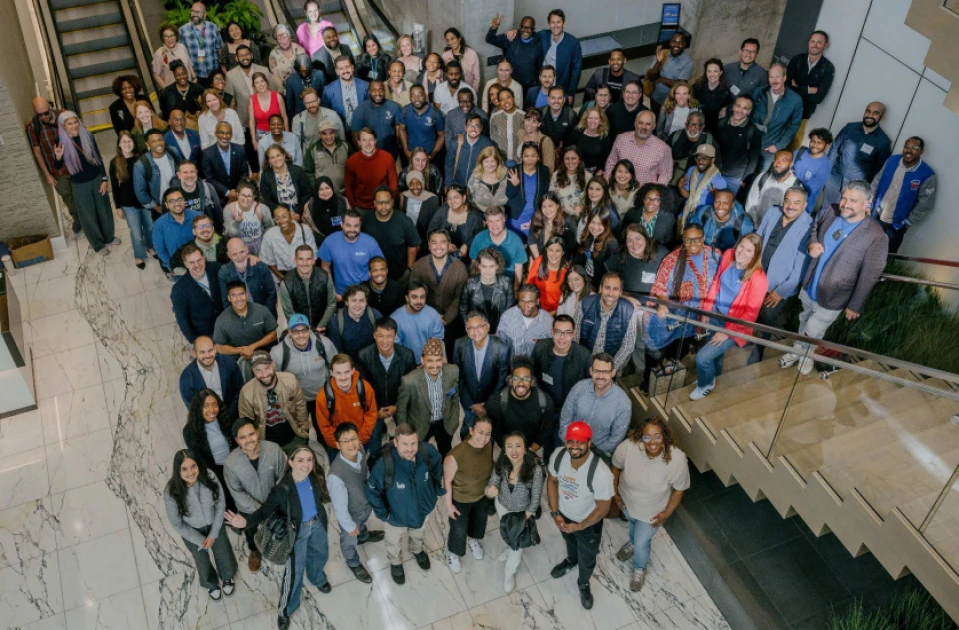
Nine African organizations have secured spots in the fourth cohort of the Amazon Web Services (AWS) Social Entrepreneur Accelerator, marking the continent’s strongest showing in the program’s history. Out of 42 social enterprises selected globally from 16 countries, Africa accounts for more than one in five a signal that the gap between African innovation and global recognition is narrowing faster than most people expected.
The selected organizations span Kenya, Nigeria, Ghana, Tanzania, Cameroon and South Africa, and their work cuts across some of the most underfunded problem spaces on the continent: youth unemployment, girls in STEM, cloud skills deserts, and community-based digital access. Delivered in partnership with Deloitte, the accelerator provides technical training, cloud infrastructure access, AI tools, and strategic business support. Since its 2023 launch, the programme has backed more than 100 social entrepreneurs across 34 countries.
Nigeria leads the continent with three organizations in this cohort.
Sabi Scholar, led by CEO Divine Iloh, is building what the team describes as an operating system for African higher education, enabling universities to launch online degree programs in 30 days. The implication is significant: for a continent where higher education enrolment remains critically low and infrastructure is a persistent barrier, compressing the institutional cycle from years to weeks is not a feature. It is a structural intervention.
Kayode Alabi Leadership, founded by Hammed Kayode Alabi, works at the intersection of mentorship and technology to reduce inequality for underserved young people. And Wetech Inc., founded by Gabriella Uwadiegwu, is building a structured pipeline for women entering tech careers through training, mentorship, and employment placement. Wetech is not just a training programme. It is an economic correction.
Kenya’s two organizations reflect a generation of founders thinking beyond classroom walls. KuzeKuze is developing digital education passports, lifelong learner records designed to make personalized educational progress portable and scalable across systems and borders. STEM Center Africa, a nonprofit co-founded by brothers Dancun and Denish Akoum and based in Oyugis, Homa Bay County, has already reached more than 18,000 students with hands-on coding, robotics, and electronics training. Ninety percent of its students gain proficiency in Python, Scratch, and electronics. The organization is aiming for 100,000 learners by 2030.
That is not a vanity metric. That is a workforce pipeline in one of the most underserved counties in East Africa.
Ghana’s BASICS International, led by Patricia Wilkins in Accra, provides digital skills certification for underserved children and young people. In Cameroon, EduCloud, founded by Rosius Ndimofor Ateh, bridges the gap between academic learning and industry through practical AI and cloud workshops — a response to a continent-wide mismatch between what universities teach and what employers actually need.
Tanzania’s Fiqra Academy, founded by Gerald Revocatus in Dar es Salaam, trains young people in digital skills and connects them to employment through a proprietary learning platform. And South Africa’s FunHouse Digital, founded by Ayabulela Yokwana in Bloemfontein, may be the most quietly radical model in the cohort: it turns gaming lounges into education hubs, using revenue from gaming to fund free coding and digital literacy training in rural communities.
That is circular economy thinking applied to social impact infrastructure. That is the kind of model that should be studied.
Jyoti Ball, General Manager for Sub-Saharan Africa at AWS, was direct about what this cohort represents. “Africa’s representation in this cohort reflects what we’re seeing across the continent,” Ball said, “a generation of founders who don’t wait for conditions to be perfect. They build anyway.” The programme, Ball said, is designed to ensure African founders have access to the same world-class cloud and AI technology available to any startup in Silicon Valley.
The parity framing matters. For too long, African social enterprises have operated at a resource deficit relative to peers in the Global North not because the problems are less urgent, but because access to infrastructure, capital, and networks has been structurally unequal. An accelerator that explicitly names Silicon Valley parity as a goal is making a policy-level commitment, not just a program pitch.
At the cohort’s conclusion, all 42 organizations will join a global alumni network of social entrepreneurs using technology to address the world’s most critical challenges.
For nine African founders, the accelerator begins now. For the communities they serve, it has already been too long in coming.

Leave a Reply