

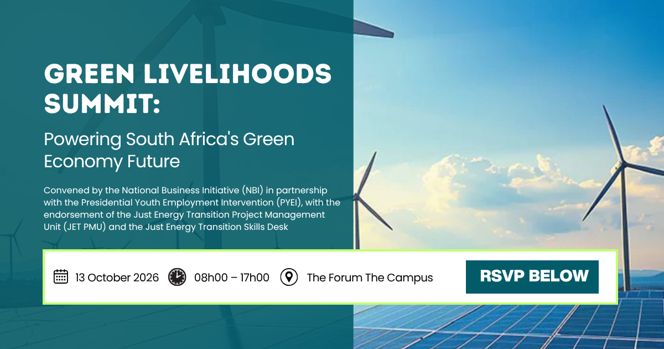
South Africa is set to host the Green Livelihoods Summit on 13 October 2026 in Johannesburg, bringing together government, business leaders, technical and vocational education and training (TVET) institutions, youth intermediaries and development partners to explore ways of turning the green economy transition into sustainable employment opportunities for young people.
The summit, organised by the National Business Initiative (NBI) in partnership with the Presidency of South Africa through the Presidential Youth Employment Intervention (PYEI), will focus on strengthening partnerships, developing relevant skills and expanding access to green jobs, with particular attention to young women.
The event is endorsed by the Just Energy Transition Project Management Unit in the Presidency and the Just Energy Transition Skills Desk. It is expected to provide a platform for stakeholders to identify practical solutions for connecting young people to emerging opportunities in a low-carbon economy. <Cite refs={[“turn217403search0”]}/>
Green Economy Transition Presents New Employment Opportunities
As South Africa advances its transition towards a decarbonised economy, demand is growing for workers with relevant technical skills, entrepreneurs capable of developing green businesses and enterprises that support sustainable economic development.
However, ensuring that young people can access these opportunities remains a significant challenge. The summit seeks to address this gap by strengthening coordination between employers, training institutions, government agencies and organisations working to improve youth employment.
According to Gugu McLaren-Ushewokunze, who will serve as Programme Director for the summit, the priority is to ensure that the green transition creates meaningful economic opportunities rather than leaving young people on the sidelines.
She emphasised the importance of equipping young people, particularly young women, with the skills, resources and opportunities needed to participate actively in shaping South Africa’s green economy.
McLaren-Ushewokunze also highlighted the need to move beyond discussions towards collective action, with stakeholders working together to align existing initiatives, strengthen partnerships and unlock opportunities for greater impact. <Cite refs={[“turn217403search0”]}/>
Summit to Focus on Skills Development and Green Enterprises
The summit will feature multi-stakeholder Action Labs designed to identify practical interventions for accelerating inclusive green economic growth.
Key priorities include aligning green employment initiatives to reduce duplication and improve implementation, expanding partnerships that support skills development and township economic growth, and strengthening donor coordination and joint funding opportunities.
These discussions are expected to help stakeholders identify areas where their programmes can complement one another and create more effective pathways from training to employment and entrepreneurship.
Improved coordination between businesses and training institutions will also be important in ensuring that skills development programmes respond to the needs of employers and emerging green industries.
By connecting young people to relevant training, enterprise support and employment networks, stakeholders aim to make the benefits of the green transition more accessible to communities that have historically faced barriers to economic participation.
Young Women at the Centre of an Inclusive Green Economy
A central theme of the summit is the inclusion of young women in South Africa’s changing economic landscape.
Although the green transition is creating new opportunities across different industries, access to technical training, business support and employment can remain uneven. The summit aims to encourage partnerships that enable young women to participate in green industries as skilled workers, entrepreneurs and leaders.
The focus also reflects the broader importance of ensuring that climate action and economic transformation contribute to reducing inequality rather than reinforcing existing barriers.
For businesses and development partners, expanding participation in the green economy offers an opportunity to combine environmental sustainability with employment creation, enterprise development and inclusive economic growth.
Building Partnerships for Sustainable Youth Employment
The National Business Initiative and its partners are positioning the summit as a platform for translating South Africa’s green economy ambitions into practical outcomes for young people.
By bringing together public institutions, businesses, training providers and development partners, the gathering will seek to identify opportunities for collaboration, improve the use of available resources and strengthen pathways into sustainable livelihoods.
The discussions will also examine how funding partnerships and coordinated implementation can help scale initiatives that prepare young people for emerging employment opportunities.
The Green Livelihoods Summit is scheduled to take place on Tuesday, 13 October 2026, at The Forum, The Campus, Bryanston, Johannesburg. Registration is scheduled to begin at 08:00, with the main programme running from 09:00 to 17:00.
As South Africa continues its transition towards a low-carbon economy, the success of these efforts will depend not only on environmental progress but also on the country’s ability to create accessible and sustainable economic opportunities.
Through stronger partnerships, targeted skills development and greater inclusion of young women, the Green Livelihoods Summit aims to advance a green economy in which young people can actively contribute to, and benefit from, the country’s economic transformation.

Leave a Reply