

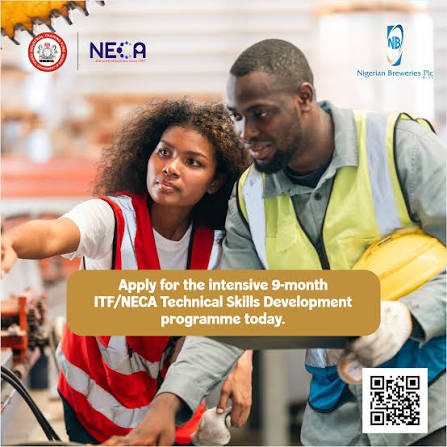
The Nigerian Education Loan Fund (NELFUND) and the Industrial Training Fund (ITF) are exploring a partnership to expand access to vocational and technical education and equip Nigerian youths with practical skills for employment and entrepreneurship.
The proposed collaboration will focus on hands-on training for artisans and aspiring craftsmen, including opportunities to learn from expatriate trainers and obtain internationally recognised certifications.
The initiative is expected to provide a practical response to Nigeria’s persistent skills gap, where the education system has often been criticised for prioritising theoretical knowledge and certificates over practical competence.
Trainees gain hands-on experience
The potential partnership comes as ITF showcases the progress of participants at one of its training centres following just three weeks of intensive practical training.
During a recent visit to the centre, ITF Director of Special Duties, Kayode Alakija, observed trainees applying their skills to real-world projects.
In the tiling section, participants recreated a functional toilet environment, including the installation of a water closet and tiling around the structure.
Meanwhile, trainees in the carpentry workshop were producing benches, racks, rafters and roofing structures.
The programme also provides training in drylining, painting and decoration, bricklaying and block making, combining classroom lessons with practical exercises designed to prepare participants for actual workplace environments.
One of the carpentry trainees, Mukta Oloriegbe, said the programme had exposed participants to workplace safety practices that are often overlooked by artisans operating within the informal sector.
Skills training seen as pathway to jobs
The initiative comes amid concerns over Nigeria’s human capital development and employment challenges.
UNICEF has reported that a significant proportion of Nigerian children aged seven to 14 struggle with basic reading and mathematics, highlighting broader challenges within the country’s education system.
The National Bureau of Statistics reported an unemployment rate of 4.3 per cent in the second quarter of 2024, while informal employment accounted for about 93 per cent of total employment.
Against this backdrop, practical technical skills could provide alternative pathways into employment, self-employment and entrepreneurship, particularly for young Nigerians seeking opportunities outside traditional academic routes.
NELFUND considers financing for vocational training
NELFUND had previously announced plans to extend its student loan programme to vocational and skills acquisition programmes following a directive from President Bola Tinubu.
In November 2025, NELFUND Managing Director, Akintunde Sawyerr, disclosed plans to expand financing opportunities to Nigerians pursuing skills development programmes.
A partnership with ITF could provide the practical training component needed to support that expansion, combining access to financing with structured technical education.
NELFUND’s existing financing platform could also provide a foundation for scaling vocational education. As of August 2026, the Fund had received approximately 1.6 million applications and disbursed more than N322 billion across 319 beneficiary institutions.
ITF plans nationwide expansion
Alakija said ITF intends to replicate the training model across Nigeria’s geopolitical zones, with artisans and master craftsmen from ITF-accredited centres also expected to gain exposure to the approach.
Trainers at the centre said participants were making significant progress within a short period.
Carpentry tutor Andy Cranham said trainees had progressed from learning basic joints to constructing truss rafters and hand-cut roofs within three weeks.
Alakija said the long-term objective was to produce thousands of skilled artisans consistently over several years, creating a pool of competent workers capable of meeting domestic demand and reducing Nigeria’s reliance on foreign artisans.
Opportunities for young entrepreneurs and MSMEs
If successfully scaled nationwide, the proposed NELFUND-ITF partnership could create new pathways for Nigerians to finance and acquire practical skills in areas such as carpentry, tiling, painting, plumbing, electrical work and bricklaying.
For MSMEs, a larger pool of trained artisans could improve access to skilled labour while creating opportunities for young people to establish and grow businesses within the technical and construction sectors.
However, the success of the proposed partnership will depend on moving beyond the exploration stage towards a sustainable national programme that combines affordable financing, quality practical training, recognised certification and clear pathways into employment and entrepreneurship.
A coordinated approach could help strengthen Nigeria’s technical workforce while giving more young people the practical skills needed to build sustainable livelihoods.

Leave a Reply